
9.05 Classifying polygons in the coordinate plane
State the properties of each of the following triangles that can be identified with coordinate geometry:
Consider the quadrilateral formed by the points A \left( - 3 , - 4 \right), B \left(5, - 4 \right), C \left(5, 4\right) and D \left( - 3 , 4\right).
Find the length of the following sides:
\overline{AB}
\overline{BC}
\overline{CD}
\overline{DA}
State if all sides of the quadrilateral congruent.
State if all consecutive sides are perpendicular.
Now, classify the quadrilateral as precisely as possible.
Consider the triangle shown.
Find the slope of the following sides:
\overline{AC}
\overline{BC}
Calculate the side lengths of all three sides.
Classify the triangle as precisely as possible.
Consider the quadrilateral ABCD.
Find the slope of the following sides:
\overline{AD}
\overline{BC}
Classify this quadrilateral as precisely as possible.
Isolda is designing a house using a graphing software. The outer pieces of the triangular roof trusses must form an isosceles triangle. The outer pieces of one of the triangular trusses is formed by three points: A \left(2,2 \right), B\left(-2, 0\right) and C \left(6, 0\right).
Calculate the following lengths:
BC
AB
AC
State if this is a possible roof truss.
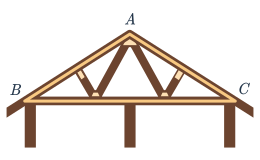
Consider the quadrilateral ABCD.
Classify this quadrilateral as precisely as possible.
Consider a quadrilateral with vertices A \left(3, 4\right), B \left(6, 2\right), C \left(5, - 3 \right), and D \left( - 4 , 3\right).
Plot the quadrilateral on a coordinate plane.
Classify the quadrilateral ABCD as precisely as possible.
Consider a quadrilateral with vertices P \left(4, - 4\right), Q \left(5, - 7\right), R \left(1, - 11\right) and S \left(0,- 8\right).
Classify the quadrilateral PQRS as precisely as possible.
A triangle consists of the points A \left(-2,-2\right), B \left(1, -4\right) and C \left(5,2\right).
Classify \triangle ABC as precisely as possible.
Consider the following lines:
Line P: y = - 6 x - 4
Line Q: y = \dfrac{x}{6} + 6
Line R: y = - 6 x - 1
Line S: y = \dfrac{x}{6} + 1
Find the slope of each line:
m_{P}
m_{Q}
m_{R}
m_{S}
State the type of the quadrilateral enclosed by the four lines.
Quadrilateral ABCD has vertices A \left(1,- 2\right), B \left(9,3\right), C \left(7,- 1\right) and D \left(- 1, - 6\right).
Show that the diagonals bisect each other and therefore that ABCD is a parallelogram.
Quadrilateral RSTU has vertices R \left(3, 0\right), S \left(5, - 3 \right), T \left(-1, - 7 \right), U \left( - 3 , - 4 \right).
Classify the quadrilateral RSTU as precisely as possible. Justify your answer.
Show that the given quadrilateral is a trapezoid, but not an isosceles trapezoid.
Consider the points P \left( - 20 , - 18 \right), Q \left(-6, -1\right) and R \left( 4 , 2\right).
Determine the coordinates of a point S such that PQRS is a parallelogram. Justify your answer.
Describe two ways in which you can show whether or not a quadrilateral in the coordinate plane is a square. Explain which method is more efficient.