
9.01 Distance and the Pythagorean theorem
For each of the following right triangles:
Determine AB.
Determine BC.
Using the Pythagorean theorem, calculate AC, rounding your answer to two decimal places if necessary.
For each of the following coordinate planes:
What is the formula for the distance between two points A \left(x_{1}, y_{1}\right) and B \left(x_{2}, y_{2}\right) on the coordinate plane?
Consider \overline{AC} that has been graphed on the coordinate plane.
Find AC, rounding your answer to two decimal places.
Find the distance between Point A and Point B, rounding your answer to two decimal places if necessary.
A \left(1, 4\right) and B \left(7, 12\right)
A \left(4, 2\right) and B \left( - 8 , - 7 \right)
A \left( - 1 , 9\right) and B \left( - 4 , 1\right)
A \left(-1, - \dfrac{3}{5} \right) and B \left(4, \dfrac{12}{5}\right)
Given P \left(4, 3\right), M \left( - 3 , - 4 \right) and N \left( - 7 , 1\right):
Find the distance from P to M, rounding your answer to two decimal places.
Find the distance from P to N, rounding your answer to two decimal places.
Determine the point that is further from P.
A circle with center at point C \left(3, 4\right) has point A \left( - 12 , 12\right) lying on its circumference. Find the radius of the circle.
ABCD is a rhombus whose vertices are A \left(1, 2\right), B \left(3, 10\right), C \left(11, 12\right) and D \left(9, 4\right). Find the exact length of the diagonals:
\overline{AC}
\overline{BD}
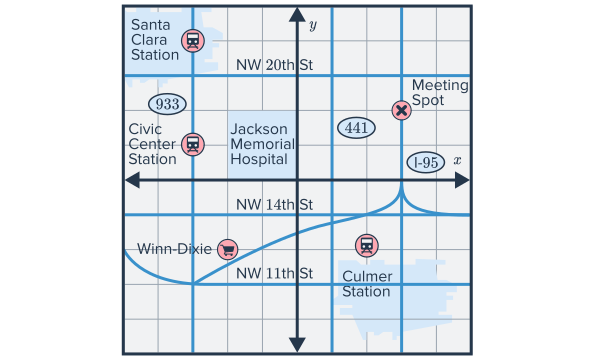
Mateo is meeting his mom at the Meeting Spot shown on the map below after a doctor's appointment. They need to catch the train home.
\overline{AM} is a vertical line segment which is 3 units long. If A is the point \left( - 2 , 6\right):
Explain the connections between the Pythagorean theorem and the distance formula.
Dayanna and David were asked for the formula for the distance between two points A \left(x_{1}, y_{1}\right) and B \left(x_{2}, y_{2}\right) on the coordinate plane.
Dayanna wrote AB = \sqrt{\left(x_{2} - x_{1}\right)^{2} + \left(y_{2} - y_{1}\right)^{2}}.
David wrote AB = \sqrt{\left(x_{1} - x_{2}\right)^{2} + \left(y_{1} - y_{2}\right)^{2}}.
Who is correct? Explain your answer.
Fyfe is asked to find the length of the line segment \overline{AB} with endpoints A \left(-4,7\right) and B \left(3,-5\right). Below is their solution.
| 1 | \displaystyle AB | \displaystyle = | \displaystyle \sqrt{\left(x_{2} - x_{1}\right)^{2} + \left(y_{2} - y_{1}\right)^{2}} | Distance formula |
| 2 | \displaystyle = | \displaystyle \sqrt{\left(3 - \left(-5\right)\right)^{2} + \left(-4 - 7\right)^{2}} | Substitution Property of Equality | |
| 3 | \displaystyle = | \displaystyle \sqrt{\left(8\right)^{2} + \left(-11\right)^{2}} | Simplify | |
| 4 | \displaystyle = | \displaystyle \sqrt{64+121} | Simplify | |
| 5 | \displaystyle = | \displaystyle \sqrt{185} | Simplify |