
1.06 Law of sines
Law of sines
Exploration
Drag the points to create any triangle.
- Complete the table of values for the triangle created. What do you notice about the relationship between the ratios of the sine of an angle and its opposite side length?
a b c A B C \dfrac{\sin A}{a} \dfrac{\sin B}{b} \dfrac{\sin C}{c} Triangle values - Create two more triangles (right, obtuse, or acute) and repeat step 1.
The law of sines is a helpful formula that connects the side lengths of a triangle to the sines of its angles. You can use it to find missing side lengths or angle measures in any oblique triangle (a triangle that isn't a right triangle).
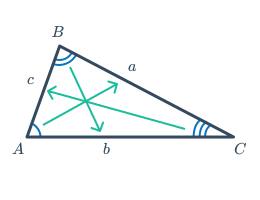
To use the Law of Sines, you need to know at least one angle and the length of the side opposite it, plus one other side length or angle measure. When you solve problems, you'll only use two ratios from the formula at a time (making a proportion).
When solving a triangle given two angles and a side (AAS) or two angles and the included side (ASA), we are guaranteed one unique solution. However, if we are given two sides and a non-included angle (SSA), the situation requires further analysis, which we will explore later.
Examples
Example 1
Consider the diagram shown below:
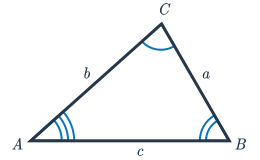
Formulate a plan for proving the law of sines: \dfrac{\sin A}{a}= \dfrac{\sin B}{b}.
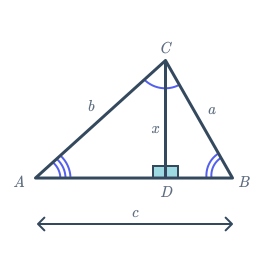
Use your plan from part (a) to prove the law of sines for any triangle.
Example 2
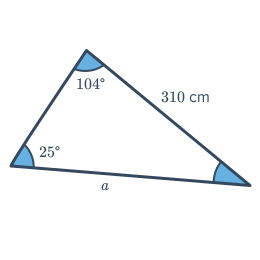
Find the value of the missing variable for the following triangles. Round to two decimal places.
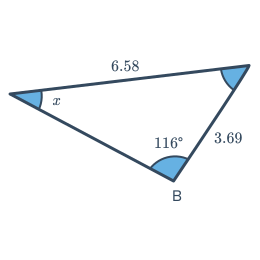
Example 3
Consider the triangle shown in the figure:
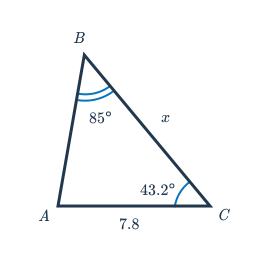
Write the proportion that relates the sides and angles of the triangle using the law of sines.
Solve for x.
Example 4
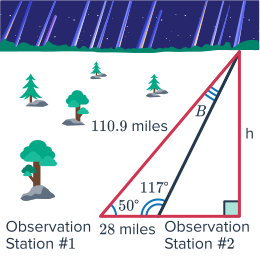
The Northern lights, or aurora borealis, are a phenomenon that occurs in the sky where particles in the atmosphere collide and create colorful night skies. Shown are two observation stations that are 28 \text{ mi} apart where scientists observe and photograph the aurora.
Find the height, h, of the aurora borealis and estimate the height to the nearest tenth of a mile.
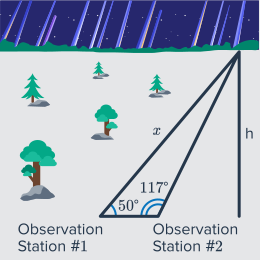
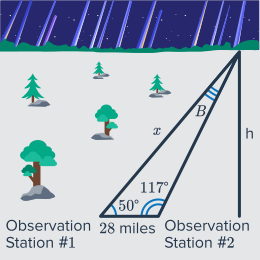
We can apply the law of sines to find missing values in an oblique triangle using the relationship:
\dfrac{\sin A}{a} = \dfrac{ \sin B}{ b} = \dfrac{ \sin C}{c}
Given Angle-Angle-Side (AAS) or Angle-Side-Angle (ASA), we are guaranteed one unique solution.
The ambiguous case
Exploration
Set the value of the length of a (red side), and the length of b (orange side). Move the point A to change the value of \angle CAB (blue angle).
Click "Can a second triangle be formed?" to see if a second triangle can be made with the lengths a and b and \angle CAB . If we were to use the sine rule on this second triangle, we would find the angle \angle AB\rq C (teal angle).
Set a=3, b=5, and \angle CAB = 34 \degree. What do you notice about the relationship between these two solutions (the orange and teal angles)?
Set a=7, b=5, and \angle CAB = 60 \degree. How many triangles are possible?
Set a=3, b=5, and \angle CAB = 50 \degree. How many triangles are possible?
What happens when a \geq b?
What happens when a \lt b?
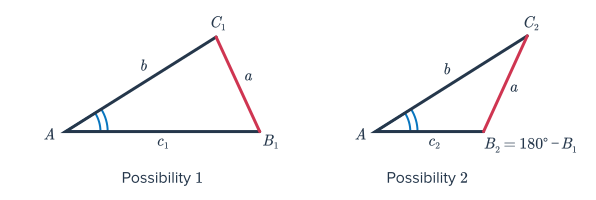
The ambiguous case occurs when using the law of sines to solve a triangle given two sides and the non-included angle. When solving the ambiguous case it is possible to have no solution, one solution, or two solutions:
Case 1: No triangle exists
This is the case when an error occurs in the calculator while solving for the unknown angle. This means that no such triangle with the given side lengths and angle exists.
Case 2: Exactly one triangle exists
This is the case when the sum of the given angle and the supplement to the solution calculated is equal to or exceeds 180 \degree. This means the potential second angle (B_2) and the original angle (A) add up to 180\degree or more, leaving no room for a third angle (C).
Case 3: Two possible triangles exist
This is the case when the sum of the given angle and the supplement to the solution are less than 180 \degree. This means the potential second angle (B_2) and the original angle (A) leave enough room (more than 0\degree) for a valid third angle (C_2). Then, the possible triangles are as follows:
- A triangle that includes the calculated solution
- A triangle that includes the supplement to the calculated solution
Examples
Example 5
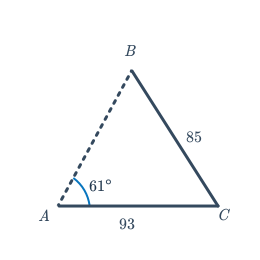
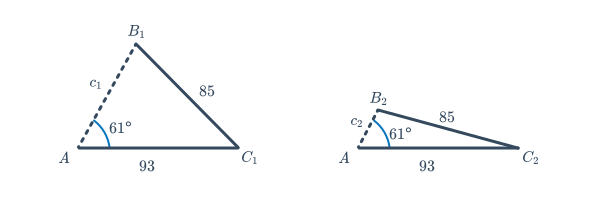
If possible, solve the triangle where a=85, b=93, and m\angle{A}=61\degree.
Example 6
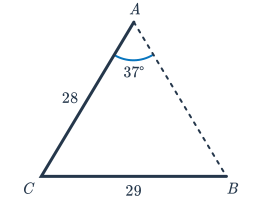
Determine how many triangles are possible given a = 29, b = 28, and m \angle A = 37 \degree. Explain your reasoning.
Assume a is the side length opposite \angle A, b is the side length opposite \angle B.
Example 7
Determine if a triangle is possible given a = 5, b = 12, and m \angle A = 40 \degree. Assume a is the side length opposite \angle A, b is the side length opposite \angle B.
The ambiguous case occurs when using the law of sines to solve a triangle given two sides and the non-included angle. Use these rules for determining the possible solution:
- Case 1: No triangle exists. This is the case when an error occurs in the calculator while solving for the unknown angle. This means that no such triangle with the given side lengths and angle exists
- Case 2: Exactly one triangle exists. This is the case when the sum of the given angle and the supplement to the solution calculated is equal to or exceeds 180 \degree
- Case 3: Two possible triangles exist. This is the case when the sum of the given angle and the supplement to the solution are less than 180 \degree. Then, the possible triangles are as follows:
- A triangle that includes the calculated solution
- A triangle that includes the supplement to the calculated solution