
In architectural drafting and similar disciplines, a detailed scale drawing of a part of a larger construction will often be produced. These drawings are needed so that the builder can proceed with the job having a clear set of instructions and specifications.
In this investigation, a scale drawing will be produced from an image of a finished product.
The following photograph is of a section of a railway bridge across the Hawkesbury River in Brooklyn, NSW. A representation of the section within the white rectangle can be made using a scale factor.
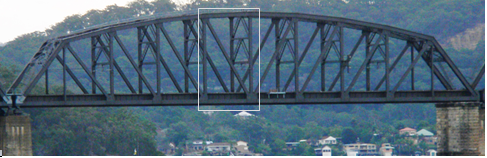
The complete bridge has eight steel trusses similar to the one pictured.
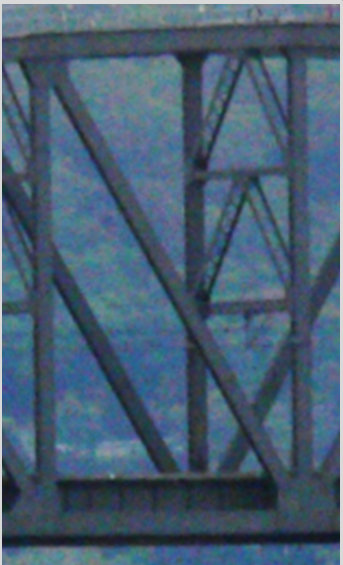
The entire bridge spans a horizontal distance of 105.92 \text{ m}. This information enables the scale factor of the photograph to be deduced and the subsequent enlargement created.
The provided photograph is already a scale representation of the object. It is assumed, for the exercise, that the span in the picture is 126 \text{ mm} or 0.126 \text{ m} . Therefore , a distance of 0.126 \text{ m} in the photograph represents 105.92 \text{ m} in the actual object. Thus, the scale is 0.126:105.92 . This scale is quite difficult to use, so it is recommended to manipulate the ratio so that the first value is equal to one. This is referred to as a unit ratio.
To determine a unit ratio this formula can be used:
\dfrac{\text{ratio } 1}{\text{ratio }1} : \dfrac{\text{ratio } 2}{\text{ratio } 1}
| \dfrac{\text{ratio}1}{\text{ratio}1} | : | \dfrac{\text{ratio}2}{\text{ratio}1} |
Write the formula |
| \dfrac{0.126}{0.126} | : | \dfrac{105.92}{0.126} |
Substitute values into the formula |
| 1 | : | 840.63 |
Calculate |
| 1 | : | 840 |
Round to the nearest ten |
Therefore the ratio will be 1:840, this means that every one unit on the scale drawing will equal 840 units on the actual object.
Your task
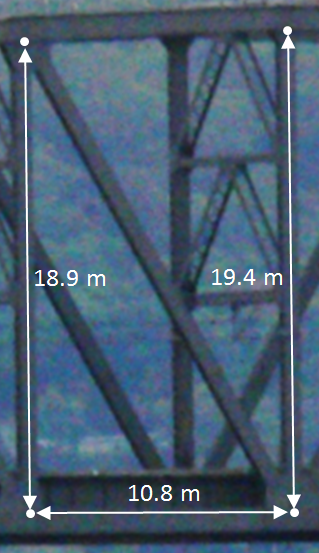
One enlarged truss from the bridge is provided. Assuming the ratio remains at 1:840, determine the missing lengths of each of the components of this section of the bridge and create a scale drawing of the section within the white rectangle in your workbook.